

Barcelona’s back-to-back La Liga titles have changed the terms of the rivalry. The second was sealed in the most pointed way possible: a 2-0 win over Real Madrid at Camp Nou, with three matches still to play and an 11-point final margin. It was more than a result. It was confirmation that, under Hansi Flick, Barcelona have become the opponent the Spanish giants cannot consistently solve. Since 2000, the Blaugrana have won 14 La Liga titles to Madrid’s nine. That gap is not a blip. It is a pattern. It is the backdrop against which Real Madrid appointed José Mourinho, but the question worth examining is whether Pep Guardiola was the better choice.
Real Madrid’s concern is not a lack of talent. With Kylian Mbappé, Jude Bellingham and Vinícius Júnior, the club boasts a front line of extraordinary promise. What the dominance of Barça has revealed, however, runs deeper: Madrid do not simply need decisive moments in big matches; they need a coherent footballing identity that can endure across seasons.
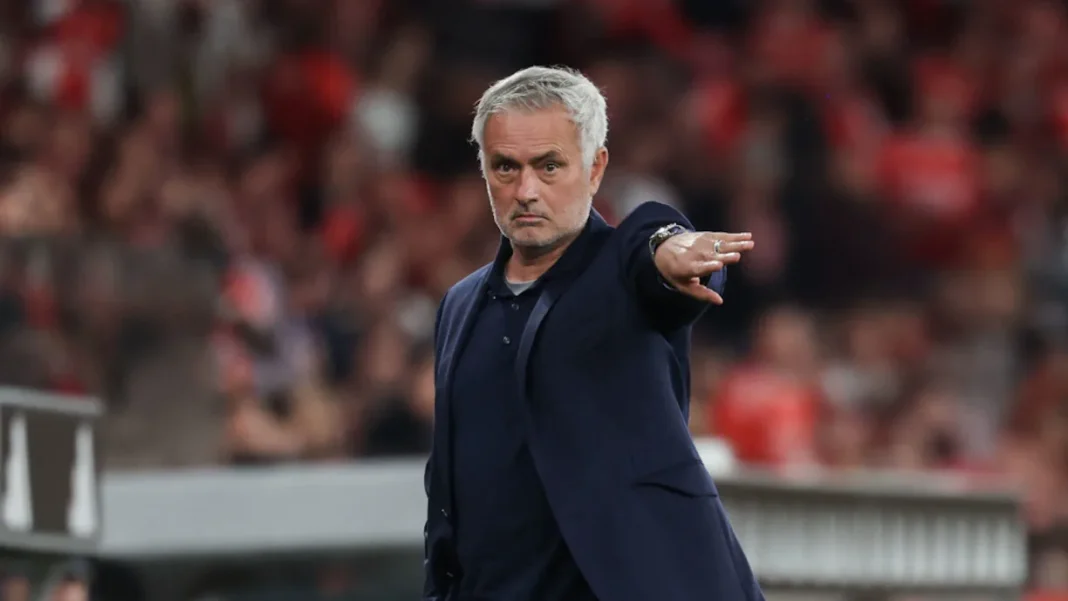
That is why Mourinho’s appointment on 11 June 2026 is a familiar solution to a modern problem. The Portuguese tactician still brings authority, edge and immediate competitiveness. Yet the Merengues face a challenge larger than winning the next Clásico. It is about constructing a team capable of preventing Barcelona from shaping Spanish football for the next five years.
The temptation of Mourinho
The case for Mourinho is not difficult to understand. He knows the club, understands its scale and has built much of his career on turning pressure into fuel. His first spell at the Santiago Bernabéu produced a 100-point La Liga season in 2011-12, with 121 goals scored, and remains one of the few occasions a team matched Guardiola’s Barcelona blow for blow. He also brings two Champions League titles, won with Porto in 2004 and Inter Milan in 2010, and a proven ability to make elite players feel the urgency of the badge. Against a Barça side that has made winning look routine, there is an obvious temptation to respond with confrontation: sharper standards, harder edges and a manager who can make defeat feel unacceptable.
Madrid’s problem is structural
The temptation is understandable. It is also insufficient. The talent available to Mourinho is extraordinary. Los Blancos clearly have enough individual quality to compete with their arch-rivals. But four of the last five major trophies won by Barça have come directly against the Bernabéu side. That is not a form problem. The more serious question is whether Madrid’s talent can be organised into a system strong enough to sustain a rivalry with a side that has built momentum, identity and tactical clarity around defeating them specifically. This is not mainly a personnel question. It is a project question.
A story of sustained success versus a story of turbulence
Few contrasts in football management are as stark as Guardiola and Mourinho, and for Real Madrid right now it is the most consequential one.
Guardiola has managed three clubs at the elite level and has never been sacked. Not once in 18 years has a president decided they had seen enough, a dressing room turned against him, or a board concluded the football was the problem. At Barcelona he informed the president of his decision months in advance, departing after four years to a standing ovation. Bayern Munich received a full year’s notice before he left, with the club describing his three seasons there as marking the end of an era. At Manchester City he chose his moment after ten years, with chairman Khaldoon Al Mubarak describing their decade together as built on honesty and trust, adding that Guardiola had not only made City better but had made football better. Every exit on his own terms. Every club stronger when he left.
For the Special One, the career trajectory tells a starkly different story. He has been dismissed seven times, with his last five clubs, Real Madrid, Chelsea, Manchester United, Tottenham and Roma, all cutting ties before the season’s end. Five boards, acting independently, reached the same conclusion: the situation had become untenable.
According to GiveMeSport, Mourinho has earned an estimated £80m from these sackings alone: £26m from Chelsea, £17m from Madrid, nearly £20m from United and £15m from Tottenham. These were not redundancy payments. They were the price of terminating a contract midstream. Real Madrid know this pattern better than most. Marca reported that during his first spell, Iker Casillas and Sergio Ramos went directly to Florentino Pérez, insisting it was either Mourinho or them. Madrid paid £17m to part ways in 2013.
Thirteen years later, Pérez has chosen to try again. The question is not whether Mourinho brings authority and competitiveness. He does. The question is whether Madrid are prepared to pay the true cost of repeating history.
What Mourinho still offers and what he no longer does
Mourinho arrives at Real Madrid in 2026 with something most managers cannot offer: the experience of having already managed the club, understood its dressing room and survived its pressure. That institutional knowledge is real and should not be dismissed. Beyond it, he brings emotional force, media authority and an instinct for turning a dressing room into something that feels personal. The question is whether that is enough for Real Madrid, a club that could have pursued Guardiola instead of Mourinho.
The risk is that Madrid are hiring the memory of Mourinho as much as the manager himself. Since Chelsea’s 2014-15 title, the Portuguese manager has not won a league crown. His Roma tenure ended with a Conference League triumph, a competition Madrid would consider beneath them, and a Europa League final lost on penalties. At Fenerbahçe he failed to reach the Champions League, with the president citing the quality of football as the reason for his departure after 14 months. Even his Benfica season, the campaign that apparently convinced Madrid he was ready for the Bernabéu again, produced an unbeaten league run that still finished behind Porto. Unbeaten, yet not champions.
In 11 years, one trophy of genuine significance. That is the line Madrid must weigh: are they investing in Mourinho’s proven aura, or in a record that increasingly belongs to the past?
What Guardiola would have changed
The manager who does not belong to the past is also the one Madrid chose not to pursue. Guardiola would have been an uncomfortable choice for Real Madrid, and not only because of his Barcelona past. He represents the footballing culture that Madrid have spent years trying to defeat. For many supporters, that alone would make his appointment almost impossible to accept.
But that discomfort is also the point. The Catalan understands Barcelona from the inside: the possession patterns, the pressing triggers, the positional discipline and the academy pathway that allows the first team to renew itself. Guardiola did not simply beat Real Madrid at Barcelona. Nine times in competitive fixtures the Catalan came out on top, including a 6-2 at the Bernabéu in 2009 and a 5-0 at Camp Nou in 2010. More importantly, he built the model that made Barça capable of beating Madrid repeatedly.
At Bayern Munich and Manchester City, he then showed that the model was not just a Barcelona inheritance. It could be adapted, modernised and exported. Across three clubs he won 40 trophies, maintaining a win rate of 70% across his 593 matches at City alone, according to the club’s official records. Rodri became the best midfielder in the world under him. Phil Foden won the Ballon d’Or in 2024. Kevin De Bruyne redefined creative midfield play. For a Madrid squad built around Mbappé, Bellingham and Vinícius, Guardiola’s value would not have been symbolic. It would have been structural: freedom within organisation, attacking talent connected by repeatable patterns, and a team that controls games rather than merely survives them.
Building to face Barcelona, not just beat them once
The central distinction between Guardiola and Mourinho is simpler than it appears, and for Real Madrid it is the most consequential one. Real Madrid do not only need a manager who can grind out one Clásico victory. They need a manager who can look at Flick’s Barcelona and construct a sustainable answer to its pressing, movement and confidence.
The current advantage held by Barça is not built only on form. It is built on clarity. Flick’s side won the title by 11 points. The 2-0 victory at Camp Nou with three games still to play was not just a result. It was a statement. Players know where to be, when to press and how to attack spaces together. Madrid’s stars can decide matches, but without a stronger collective structure they risk becoming a collection of brilliant solutions to problems the team keeps recreating.
Guardiola’s appeal, in this context, is not nostalgia for his Barcelona team. It is the evidence that he can turn elite individuals into a shared mechanism. Mbappé, Bellingham and Vinícius are precisely the players who would thrive in that environment: a finisher who demands space, a midfielder who arrives late into it and a winger who creates it from nothing. The question is whether Madrid wanted a system that could make their players greater together, or a manager who could make them angrier for the next battle.
The question Madrid should have asked
The debate around Mourinho’s appointment has often focused on personality, history and revenge. Those are powerful themes at Real Madrid, but they are not the most important ones. The better question is simpler: which manager gives Madrid the clearest route to becoming the best coached team in Spain again?
That question was never seriously asked. In the presidential election that preceded Mourinho’s appointment, Florentino Pérez’s opponent Enrique Riquelme told Spanish newspaper ABC he was “never a fan of Mourinho” and envisioned a long-term project for the club. Speaking to COPE radio, he revealed he had already finalised an agreement with another manager before announcing his candidacy, describing him only as “not currently available.” That manager turned out to be Jürgen Klopp, though Klopp’s agent Marc Kosicke closed the door within hours of Riquelme naming him publicly, telling Sky Sport Germany that Klopp was happy at Red Bull and had no ambitions to return to club football. One presidential candidate was asking the right question. The other reached for a familiar name.
That is why Guardiola made more sense for Real Madrid than Mourinho. He would have forced Madrid to confront Barcelona at the level of ideas, not just emotions. Mourinho can still create urgency. Guardiola would have created a framework.
The verdict
Mourinho may yet win at Real Madrid. The squad is too talented to dismiss, and his competitive instinct can still sharpen a dressing room quickly. But Barcelona’s challenge is bigger than one season and deeper than one rivalry week. Flick’s team has structure, a system still developing and Lamine Yamal at 18. Madrid’s response needed to be just as durable.
That is why Guardiola made more sense. He was not the sentimental choice, or the easy one. He was the manager whose football most directly answered Madrid’s real problem: turning immense talent into a clear, modern and lasting identity.
Madrid needed a builder. They chose a fighter. It may win them matches. It is harder to see it winning them the era.
And in this rivalry, winning the era is the only victory that truly matters.
Do you think Real Madrid made the right call choosing Mourinho over Guardiola? Let us know in the comments below.