
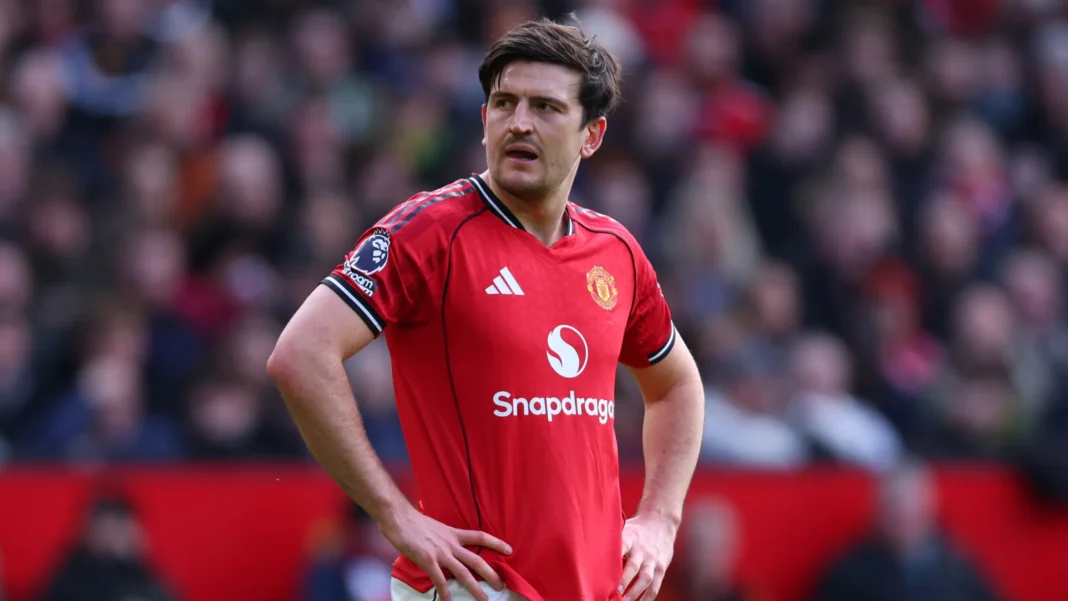

The date was August 5, 2019. Manchester United had just broken the world record transfer fee for a defender, paying Leicester City £80 million for a Sheffield-born centre-back who had impressed in the Premier League but had never played Champions League football, never won a major trophy and never been tested at the very highest level of European competition. His name was Harry Maguire. And from the moment that fee was announced, the weight of it never truly left him.
It is worth pausing on that number. £80 million. In the summer of 2019 it was not just a club record; it was a statement. Twelve months earlier, Liverpool had paid £75 million for Virgil van Dijk and watched him transform their entire defensive identity almost overnight. The implicit message in United’s fee was clear: they believed they had found their own Van Dijk. A commanding, ball-playing, leader-of-the-backline who would do for Old Trafford what the Dutchman had done for Anfield. It was an extraordinary claim to make about any footballer. It was an especially extraordinary claim to make about the former Leicester man.
The Weight of Expectation
The first season of Harry Maguire was, by any reasonable measure, a success. United’s defence improved. The Sheffield-born defender was consistent, commanding in the air and composed on the ball. There were glimpses of exactly the player the fee had promised. Then the pandemic arrived, the season restarted behind closed doors, and something shifted. Without the roar of Old Trafford to carry him, without the rhythm of a normal football calendar, the cracks that high-pressure football eventually finds in every defender began to appear.
The errors came. Not constantly, not relentlessly, but in the moments that mattered most. A mistake in a Champions League tie. A loss of concentration in a derby. The kind of high-profile, high-stakes failures that are brutal for any defender but which become defining when you cost £80 million and the entire back page is watching. Erik ten Hag stripped Harry Maguire of the captaincy in 2023, with the defender publicly stating he was “extremely disappointed” but vowing to continue giving everything for the club. For many United supporters it felt like a formal acknowledgement of what they had long suspected: that the world’s most expensive defender had simply never justified the investment.
Then came the Mykonos incident of August 2020. After leaving a bar on the Greek island, the centre-back became involved in an altercation that, according to authorities, included insulting and assaulting police officers, resisting arrest and attempted bribery. He has always maintained his innocence, claiming he acted to protect his sister. The social media abuse that followed was unlike anything most footballers have experienced: relentless, personal and completely disproportionate regardless of where the truth lay. The story refused to stay buried. In March 2026, a Greek court handed the defender a 15-month suspended sentence at retrial, convicting him on all three counts, with his legal team immediately confirming an appeal to the Greek Supreme Court. It is a chapter that refuses to close, and one that has followed him throughout every subsequent stage of his career at Manchester United.
The Rebuild Nobody Noticed
And yet, when the noise was at its loudest, Maguire did something that his critics perhaps least expected. He stayed. He worked. He said very little and let his performances do the talking.
Under Michael Carrick, the transformation became visible. A manager who demanded defensive discipline and organisational intelligence found in the England international exactly the profile he needed anchoring his back three. The errors that had defined the narrative did not disappear entirely, they never do for any defender, but they became less frequent, less costly and less central to the story. This season he has made 23 Premier League appearances, accumulating 1,655 minutes of playing time, contributing one goal and two assists while starting 19 of those fixtures. Quietly, consistently and without fanfare, the 33-year-old had become one of United’s most reliable players.
The underlying numbers tell the same story: 16 tackles won, 101 clearances and a ground duel success rate of 65.52 per cent across 22 Premier League appearances this season. These are not the statistics of an overrated footballer. They are the statistics of a solid, experienced Premier League centre-back doing his job with the kind of professionalism that the years of abuse never managed to erode.
Manchester United rewarded that professionalism on April 7, 2026, confirming a new contract extending his stay until June 2027 with the option of a further year. The defender’s own words upon signing were telling: “I am delighted to extend my journey at this incredible club to at least eight seasons and continue to play in front of our special supporters to create more amazing moments together.” It was the clearest possible signal that the club had reached its own verdict, and that verdict was not the one the boo boys had written.
The England Paradox
Perhaps the most telling chapter in this story has nothing to do with club football at all. Throughout the years of hostility at Old Trafford, something curious was happening at international level: the defender was performing. Consistently, reliably and under the greatest pressure the game has to offer, the centre-back who was being pilloried by his own supporters on Saturday afternoons was becoming one of England’s most important players on Tuesday evenings.
Under Gareth Southgate, he was trusted without hesitation across three major tournaments spanning eight years. The boos that rang out at Old Trafford never seemed to follow him to Wembley. He started major tournament games and delivered. His teammates respected him. His manager believed in him. He won 66 caps and played in three major tournaments, becoming one of the most decorated England defenders of his generation.
Then came Thomas Tuchel; and a final, painful twist. Despite a strong season at club level and a recall for England friendlies against Uruguay and Japan, Harry Maguire was left out of Tuchel’s 26-man squad for the 2026 World Cup, admitting he was “shocked and gutted” by the decision. Tuchel acknowledged the defender had “had an outstanding season” but stood firmly with the central defenders who had carried England through the qualification campaign. It was a brutal conclusion to an international career that had defied so much adversity — and one that raised its own uncomfortable question: if he was good enough to rebuild his United career, sign a new contract and deliver an outstanding club season, was the Tuchel omission a football decision or a statement about age and the future?
The Honest Verdict
So, is Harry Maguire overrated? The honest answer is: it depends entirely on what you are measuring him against.
Measured against the £80 million fee and the Van Dijk standard that fee implied, yes, almost certainly. In 266 appearances for Manchester United, he has scored 17 goals, helped the club win both the FA Cup and the League Cup, and established himself as one of the most experienced defenders in the division. Those are not the numbers of a disaster. They are the numbers of a very good Premier League defender who was purchased as if he were a generational one. The difference between those two categories is meaningful; but it is not as vast as seven years of narrative would have you believe.
But measured as a footballer in isolation, stripped of the fee and the noise and the narrative that has surrounded him since the moment he arrived at Old Trafford? The verdict is considerably more complicated. He is 33 years old, under contract until 2027, and still starting Premier League fixtures for one of the most scrutinised clubs on the planet. He has played in three major tournaments, earned 66 caps and scored seven international goals. That is not the career of an overrated footballer. It is the career of a good one who was purchased as if he were a great one, and who has spent seven years quietly, stubbornly refusing to be defined by the gap between those two things.
The real error was never Maguire. The real error was the £80 million fee that turned a good defender into a symbol, a target and a referendum on everything that was wrong at Manchester United. The fee wrote the story. He just had to live in it.
One thing is beyond dispute: the full story of the world’s most expensive defender at Manchester United is far more interesting, far more nuanced and far more human than the narrative that dominated it for so long. The World Cup omission is the final chapter, for now. Whether that makes him overrated or simply misunderstood is still, after all of this, a question worth arguing about.
What do you think of Harry Maguire? Seven years, £80 million and a World Cup snub; overrated or simply misunderstood? Share your thoughts in the comments below.