
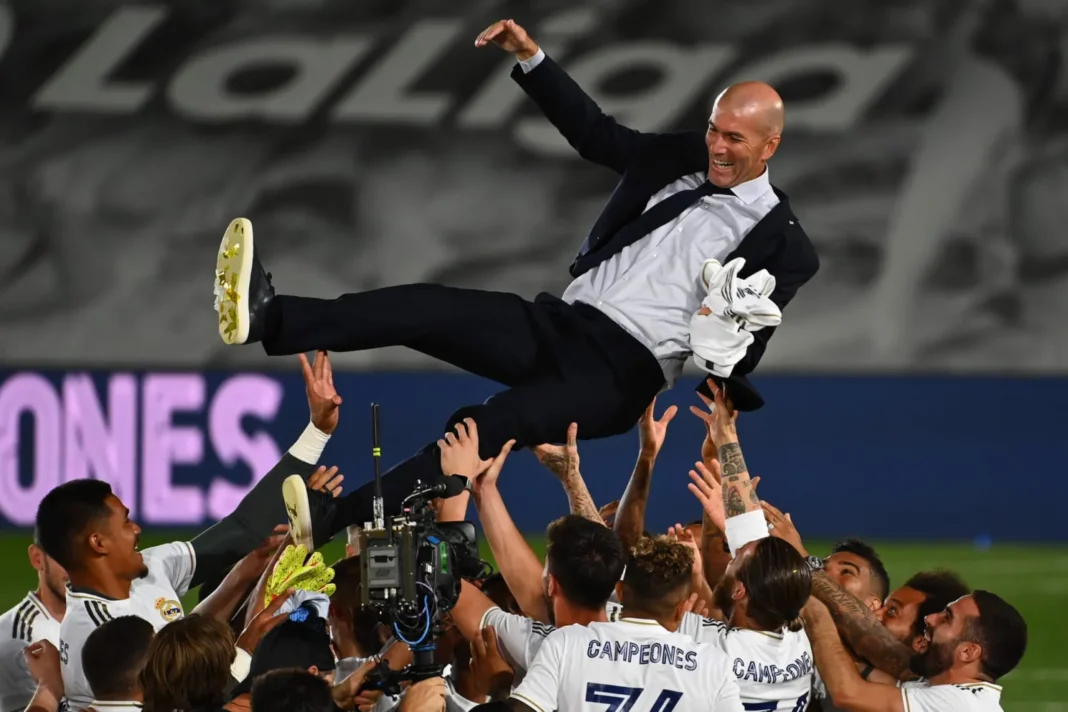

Zinedine Zidane left Real Madrid without warning. No speculation building over weeks, no leaks to trusted journalists, no hints dropped in press conferences. Zidane walked into the Santiago Bernabéu on the morning of 31 May 2018, the morning he was due to sit down and plan for the following season, and announced he was leaving. The club had just won three consecutive Champions League titles and were suddenly without a manager.
The football world’s reaction was somewhere between shock and bewilderment. The Frenchman had just become the first manager in history to win the Champions League three times in a row. He had done it with a squad that was not universally considered the most talented in Europe, in a league where Barcelona had spent much of the same period dominant, and with a style of play that drew persistent criticism for its lack of tactical sophistication. Yet the results were undeniable, and the timing of his departure, coming just days after a 3-1 victory over Liverpool in Kyiv, felt almost inexplicable.
Almost. Because when you look closely at the situation Zidane was inheriting for the 2018-19 season, the picture becomes considerably clearer. This was not an impulsive decision. It was the calculated exit of a man who understood precisely what was coming and chose not to be there when it arrived.
The squad was about to fall apart
In the aftermath of the Champions League final, two of Los Blancos’ biggest names made comments that sounded uncomfortably like farewell speeches. Cristiano Ronaldo, speaking on the pitch in Kyiv, said, notably in the past tense, that it had been “very nice to be at Real Madrid”, and strongly hinted that a new challenge was calling. Gareth Bale, whose overhead kick had effectively won the final, said he needed to be playing regularly and that his situation at the club needed to be resolved.
Neither man was wrong. Ronaldo had spent 12 months in open tension with club president Florentino Perez over a new contract. The Welshman had spent large portions of the previous two seasons watching from the bench, and reports at the time suggested the relationship between the two had grown strained. Both appear likely to follow. Ronaldo has strongly hinted at a new challenge; Bale has made clear he wants regular football, which Madrid cannot guarantee.
The squad Zinedine Zidane had built at Real Madrid over two and a half years was dissolving around him, and the rebuilding process would be enormous. More significantly, Perez’s vision for that rebuild did not always align with his own. The president wanted to protect certain players; Zidane had his own ideas about who needed to go. Faced with the prospect of a summer of boardroom battles over players he did not want and a dressing room in flux, he chose to leave before the argument started rather than lose it from the inside.
The peak had been reached. What follows a peak is descent
At his resignation press conference, Zinedine Zidane spoke with a candour few managers would dare. “After three years, Real Madrid needs a change, another way of working, another idea, if we are to continue winning. I feel it’s going to be difficult to continue winning. And because I’m a winner, I’m going.”
In those words lay the paradox of his greatness: a manager who had conquered Europe three times in succession, yet chose to walk away at the summit rather than risk decline. It was not weakness but foresight, an acknowledgment that even dynasties require renewal, and that his own aura could fade if he lingered too long. By departing at that moment, he safeguarded both his legacy and his sanity, leaving Madrid facing the turbulence of transition without the stabilising presence that had defined their golden run.
That was not the language of a man bereft of ideas or drained of conviction. It was the language of someone fluent in probability. Three consecutive Champions League triumphs, a feat unseen since the dynasties of the 1950s and 60s, made the notion of a fourth almost statistically implausible. The margins required to prevail in knockout football at the highest level, season after season, are vanishingly small. The same core of players, carrying the weight of expectation while facing opponents ever more determined and better prepared, could only be stretched so far before the cycle inevitably broke.
What Zidane grasped better than most critics would admit is that managing Real Madrid is as much about deflecting blame as it is about collecting trophies. Had he stayed and Madrid suffered an early Champions League exit, the narrative would almost certainly have cast Zidane as a manager who had run out of ideas. Whether that verdict would have been fair is another question entirely. By walking away, he safeguarded both his legacy and his sanity, leaving Madrid to navigate the uncertainty of a new era without him.
The tactical questions were never going to go away
For all his triumphs at Real Madrid, Zinedine Zidane carried a lingering accusation: that the team’s success came in spite of him rather than because of him. After all, he presided over a squad stacked with generational talent: Ronaldo, Bale, Benzema, Modrić, Kroos, Ramos, Marcelo, all in their primes. The charge was that any competent manager could have delivered trophies with such resources, and that Zidane’s own fingerprints were faint: team selections reactive, formations conservative, substitutions often puzzling.
There is truth in the criticism, though it undervalues the man-management required to keep a dressing room of that size and ego functioning at the highest level for 30 months. Should Ronaldo depart, and with an ageing squad entering transition, the tactical shortcomings that individual brilliance had long concealed would inevitably surface. A manager whose reputation was built on winning would suddenly be judged on style, on patterns, on invention. That was a different contest altogether, one he had no interest in fighting.
Leaving Real Madrid means Zinedine Zidane exits the stage on his own terms. The questions about his tactical credentials will follow him, but they will be asked of a man who won nine trophies in two and a half years. Whatever comes next, he has ensured that his Real Madrid story ends the way he wanted it to: at the top, and on his own clock.
The true shock of Zidane’s departure was not that he left, but that he read the situation with such clarity, so early, and acted decisively on what he saw.